A booking may look worthwhile until you realize that reaching the client requires 45 minutes of driving each way.
For a mobile massage provider, travel is part of every appointment. That makes choosing the right mobile massage provider travel radius one of the most important decisions when setting up or adjusting a service area.
A larger radius may give you access to more potential bookings, but it can also create longer drives, difficult scheduling, and large gaps between appointments. A smaller radius may be easier to manage but could limit the number of locations where you are available.
The goal is not to cover as much of Toronto and the GTA as possible. It is to choose areas that make practical sense based on travel time, location, availability, and the value of each booking.
Table of Contents
- At a Glance – Key Takeaways
- What Is a Mobile Massage Provider Travel Radius?
- How Far Should a Mobile Massage Provider Travel in Toronto?
- What Should You Consider When Choosing Your Mobile Massage Service Area?
- How Travel Time Between Bookings Changes the Value of an Appointment
- How to Build a Practical Mobile Massage Coverage Area Across the GTA
- When Should You Expand or Reduce Your Mobile Massage Provider Service Radius?
- Frequently Asked Questions
- Summary
- About Instant Masseuse
At a Glance – Key Takeaways
- Your travel radius should be based on time, not kilometres alone.
- Toronto traffic can make two locations with the same distance very different to serve.
- Long travel times can reduce the number of appointments you can accept in one day.
- Nearby bookings are usually easier to schedule together.
- Your coverage area can change by time of day or day of the week.
- You do not need to serve every part of Toronto or the GTA.
- A clearly defined service area can make scheduling more predictable for both providers and clients.
What Is a Mobile Massage Provider Travel Radius?
A mobile massage provider travel radius is the distance or travel area a massage practitioner is willing to cover when going from their starting location to a client’s home. A practical radius considers driving time, traffic, appointment length, availability, and how easily multiple bookings can fit into the same schedule.
It can be tempting to define your radius using a simple number such as 10, 20, or 30 kilometres.
However, distance alone does not tell you how practical a booking will be.
Ten kilometres in one part of the GTA may take 15 minutes. The same distance in another area during rush hour could take much longer.
That is why many providers are better off thinking in terms of maximum travel time rather than kilometres alone.
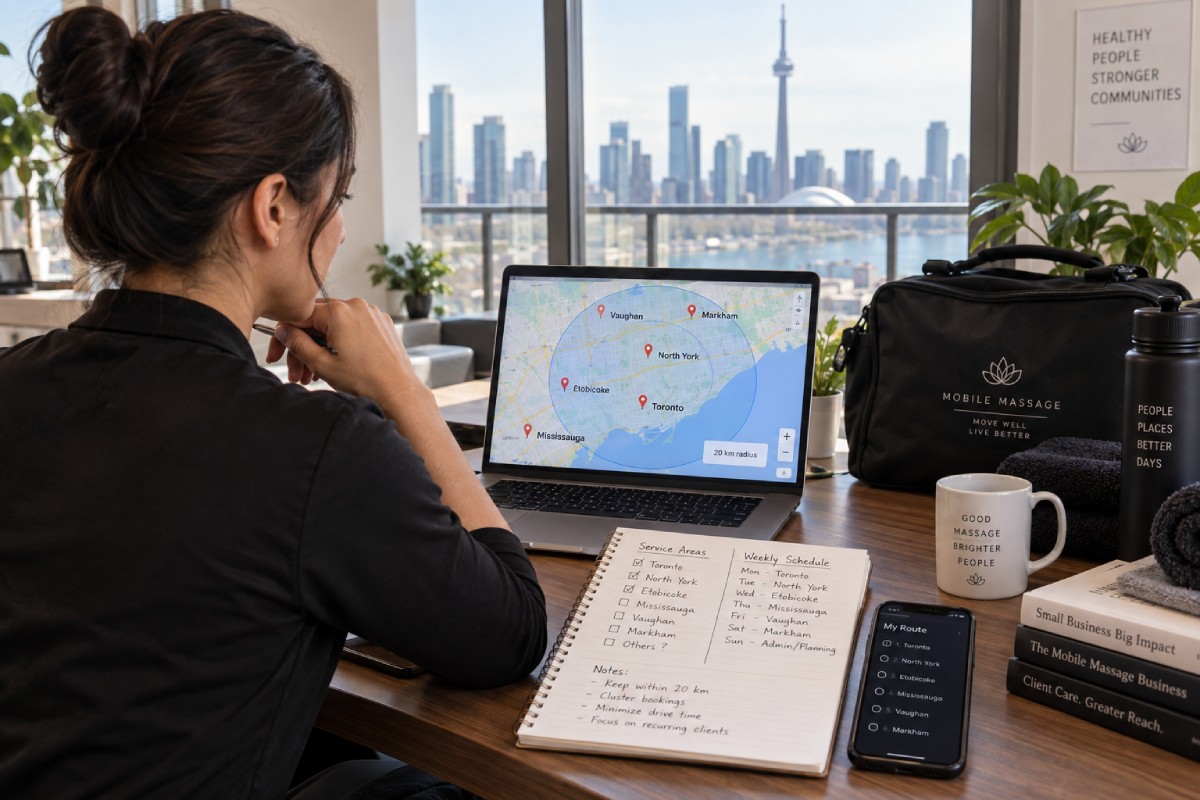
For example, you might decide that an appointment is practical when it requires no more than 20 or 30 minutes of normal travel from your starting point.
That creates a more realistic mobile massage service area than drawing a large circle on a map.
Your starting point also matters.
Some providers begin their day from home. Others may already be in another neighborhood after completing an earlier booking.
As your schedule develops, the distance between appointments can become just as important as the distance from your home.
How Far Should a Mobile Massage Provider Travel in Toronto?
A mobile massage provider should travel only as far as allows the appointment to fit comfortably into the day without creating excessive driving or scheduling pressure. The right distance varies by provider, but travel time, traffic patterns, appointment length, and nearby booking opportunities should all influence the final radius.
There is no single correct number for every provider.
A radius that works well for someone in North York may not make sense for someone based in Scarborough, Markham, Vaughan, or downtown Toronto.
Travel Time Matters More Than Distance
When choosing service areas for mobile massage in Toronto, travel time is often more useful than kilometres alone. Traffic can make the same distance easy at midday and difficult during rush hour. Providers may therefore choose a wider radius during quieter periods and stay closer to their current location when traffic is heavier.
What Should You Consider When Choosing Your Mobile Massage Service Area?
A practical mobile massage service area should reflect how you actually work. Travel time, appointment length, traffic, parking, demand, and the distance between bookings should all be considered before adding an area to your regular coverage.
Travel Time and Traffic
Start with the location where most working days begin and check realistic travel times to the areas you want to serve. Look at different times of day rather than relying on one ideal route. Toronto traffic can significantly change whether a location fits comfortably into your schedule.
Distance Between Appointments
Do not evaluate each booking only by its distance from home. Consider where your previous and next clients are located. Two appointments in nearby areas may work well together, while bookings on opposite sides of the GTA can create unnecessary travel and large scheduling gaps.
Appointment and Access Time
Include the full-time commitment when deciding whether an area makes sense. In addition to the massage session, allow time for driving, parking, condominium access, elevators, and reaching the client’s unit. Your mobile massage provider service radius should fit your available working hours without forcing appointments too close together.
How Travel Time Between Bookings Changes the Value of an Appointment
Travel time changes the real time commitment of every mobile massage booking. A 30-minute appointment may require significantly more than 30 minutes of your day once driving, parking, building access, and travel to the next client are included.
Consider two simple examples.
A client lives 15 minutes away.
You drive there, complete the appointment, and return or continue to another nearby client.
Now compare that with a booking that requires 50 minutes of travel each way.
The massage session itself may be identical, but the total time committed to the second booking is much greater.
This is why travel time should be considered when evaluating whether an area makes sense for your schedule.
Calculate the Full Booking Window
Instead of thinking only about the massage session, think about the full booking window:
Travel to the client + arrival time + massage session + departure + travel to the next location.
This gives you a clearer picture of how much of your working day the appointment actually uses.
Avoid Scheduling Appointments Too Tightly
Trying to fit appointments too close together can create unnecessary pressure.
Traffic can change suddenly. Parking can take longer than expected. A condominium elevator may be delayed.
Leaving a reasonable buffer helps protect your schedule.
It also makes it easier to arrive at each appointment without rushing.
Group Nearby Appointments When Possible
One of the most practical ways to manage a larger service area is to group bookings geographically.
For example, if you already have an appointment in Mississauga, another nearby appointment may be easier to accommodate than returning across Toronto.
Over time, providers can learn which areas work naturally together.
This can make a wider service area easier to manage without increasing unnecessary driving.
How to Build a Practical Mobile Massage Coverage Area Across the GTA
A practical mobile massage coverage area should start with locations you can reach consistently and expand only when additional areas fit your schedule. Toronto and the GTA are large, so dividing your coverage into smaller zones can be more useful than treating the entire region as one service area.
Start with your most convenient zone.
This may include your own neighborhood and surrounding communities that are usually easy to reach.
Then create a second zone for locations that require more travel but are still realistic under the right conditions.
For example, your coverage might look something like this:
Primary area: locations you are normally willing to serve.
Extended area: locations you may serve depending on time and availability.
Outside area: locations that usually require too much travel to fit comfortably into your schedule.
You do not need to publish these exact categories for customers.
They can simply help you make more consistent booking decisions.
Consider Toronto and GTA Areas Separately
Toronto, Scarborough, North York, Etobicoke, Mississauga, Vaughan, Richmond Hill, Markham, Pickering, Ajax, Oakville, Burlington, and other GTA communities should not automatically be treated as one travel zone.
The distances and travel routes between them vary significantly.
Serving several GTA locations can work well, but your availability may need to depend on where you are already working that day.
For instance, a Richmond Hill appointment may make sense when you already have another booking in Vaughan.
The same Richmond Hill booking may be much less convenient if your previous appointment is in downtown Toronto.
When Should You Expand or Reduce Your Mobile Massage Provider Service Radius?
You should consider changing your service radius when your current travel pattern regularly creates too much driving, difficult scheduling, or missed opportunities in nearby areas. Expansion should be based on actual booking patterns and travel conditions rather than simply trying to cover more locations.
Signs You May Be Able to Expand
Expansion may make sense when:
- You frequently receive requests from a nearby area.
- Travel time to that area is manageable.
- You already serve adjacent neighborhoods.
- You can combine appointments within the same general area.
- Your current schedule has room for additional travel.
Expand gradually rather than adding several distant areas at once.
This allows you to see how each new location affects your actual schedule.
Local SEO Should Match Your Real Service Area
Local SEO for mobile massage businesses should reflect locations that providers can realistically serve.
If your website mentions an area, customers may reasonably expect appointment availability there.
That means your online coverage should stay aligned with your operational coverage.
There is little value in attracting searches from locations that rarely make sense for your providers to visit.
Accurate location targeting can help connect people looking for mobile massage in Toronto with providers who are actually available in their part of the city.
If you provide relaxation-focused in-home massage in Toronto or the GTA, choosing a realistic service area can make each working day easier to organize. Instant Masseuse allows customers to search for available providers based on their location, helping providers focus on areas they are comfortable serving.
Frequently Asked Questions
How far should a mobile massage provider travel?
A mobile massage provider should travel within a distance that fits comfortably into their schedule after driving time, traffic, parking, and appointment length are considered. Rather than choosing a fixed number of kilometres, providers may find it more practical to set a maximum normal travel time for each booking.
How do I choose my mobile massage service area in Toronto?
Start with neighborhoods that are easy to reach from your normal starting location, then compare typical travel times at different hours. Consider traffic, parking, client demand, and the distance between appointments. Your regular service area should include locations you can serve consistently without making your schedule unnecessarily difficult.
Should I use kilometres or travel time to set my service radius?
Travel time is often more useful than kilometres in Toronto because traffic conditions vary significantly between neighborhoods and times of day. A 15-kilometre booking may be easy at one time and difficult at another. Providers can use distance as a guide but should base final decisions on realistic travel times.
Can my mobile massage coverage area change during the day?
Yes. A flexible coverage area can be practical for mobile massage providers. You may be comfortable travelling farther during quieter traffic periods and staying closer to your current location during rush hour. Availability can also depend on where previous appointments have taken you during the day.
How should I schedule mobile massage bookings in different GTA areas?
Try to group appointments in the same general part of the GTA whenever possible. Nearby bookings reduce unnecessary back-and-forth driving and make travel times easier to predict. Before accepting an appointment, check not only the client’s distance from home but also the location of your previous and next bookings.
When should I expand my mobile massage provider service radius?
Consider expanding when you regularly receive requests from an area that is reasonably easy to reach and fits with your existing bookings. Test the new location gradually. If travel remains manageable and appointments can be scheduled without excessive gaps, the area may be suitable for regular coverage.
Summary
Choosing a realistic mobile massage provider travel radius is not about serving the largest possible area. It is about deciding where you can travel consistently without allowing driving, traffic, and distance between bookings to take over your working day. Start with manageable locations, track real travel times, group nearby appointments when possible, and adjust your coverage as your booking patterns become clearer.
About Instant Masseuse
Instant Masseuse is a Toronto-based platform connecting customers with independent massage practitioners who provide relaxation-focused massage services in clients’ homes.
For providers, the platform helps connect appointment requests with the locations they choose to serve. For customers searching for mobile massage near me in Toronto, this creates a simpler way to find available in-home massage options based on location.